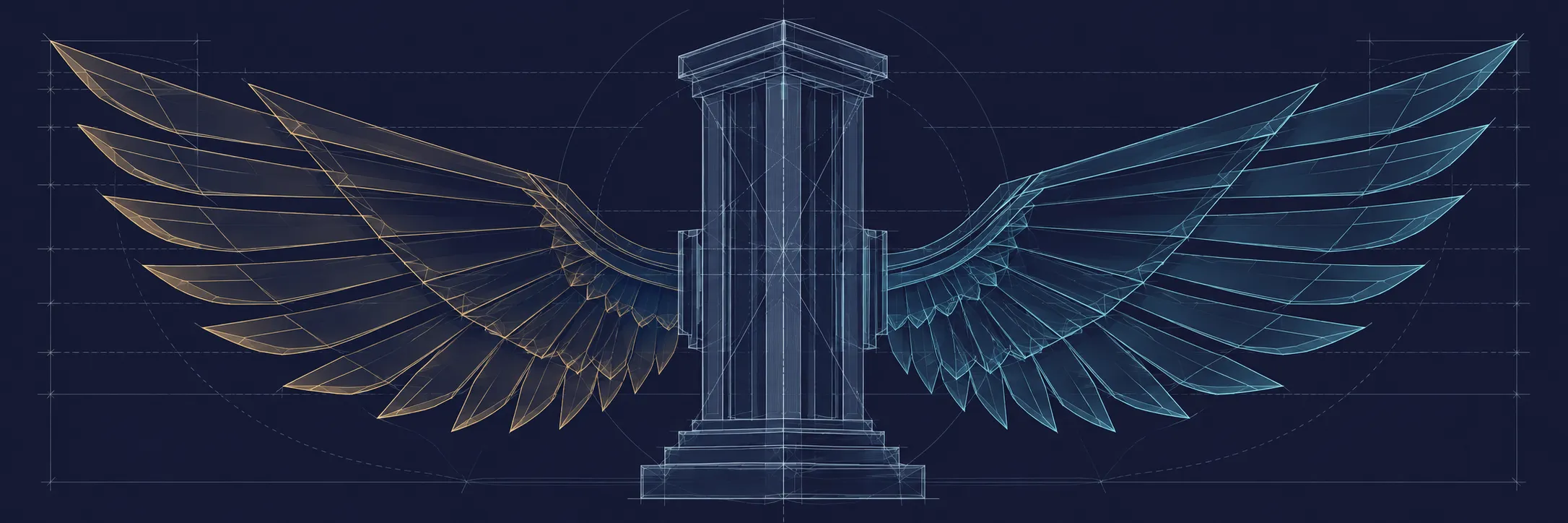
The Two Wings AI Framework
Deploy AI at Scale
- 1
- 2
- 3
- 4
- 5
- 6
- 1
- 2
- 3
- 4
- 5
- 6
Your AI agents can act on their own.
Accountability for what they do stays with you.
TWAF puts evidence of business value and trust behind every decision to deploy.
The deployment decision
Your AI agent works in the pilot. Is it ready to act at scale?
Imagine an AI agent that completes a government service end to end on a citizen's behalf, and is ready to leave the pilot.
The Pilot
The agent completes the service in the user's name.
The Decision
How far the agent may act alone, with people on the loop and a tested stop switch within reach.
The Stakes
Citizen trust in AI services.
The success of the whole AI transformation.
A working pilot does not establish readiness to act at scale.
02
Why the decision needs evidence
Scale needs evidence of both value and trust.
Two questions, asked from day one and answered with evidence at every stage.
Value
Is this the right AI?
A safe agent can still consume resources without improving the service.
Trust
Is the AI done right?
A capable agent can still act beyond its mandate and erode public trust.
Design for value and trust from day one. Scale on evidence of both.
03
The method
Value and Trust meet at the AI Decision Gate.
Six elevations on each wing. One decision on whether to scale.
Value/Is the AI worth doing?
- 1AI-Worthy Processes
- 2People & Change Readiness
- 3ROI & Value Modeling
- 4Pilot Value Proving
- 5Value Capture & Ownership
- 6Portfolio & Scale Economics
Decision
Gate
Trust/Are we doing AI right?
- 1AI-Ready Data
- 2AI Visibility & Ownership
- 3Model & Output Assurance
- 4Agentic & Runtime Control
- 5Human Oversight & Accountability
- 6Compliance & Evidence
Each wing is only as strong as its weakest level, scores are not averaged, and neither wing can make up for the other.
Download the full research paper at SSRN
04
The AI Decision Gate
The Production Decision Surface
The lattice captures the scores on both wings: only one cell earns a Go Live decision. A Dangerous Demo or an Over-Governed Waste verdict points to the specific box that failed, and the first step is to fix that box, not to abandon the use case. Retiring a use case is for failures in the foundations, or where the fix costs more than the value at stake.
Over-Governed Waste
Low Value · High Trust
safe but resource-consuming; no return
Go Live / Scale
High Value · High Trust
the only outcome that earns production
Drop
Low Value · Low Trust
no value and no safety; discontinue
Dangerous Demo
High Value · Low Trust
impressive, ungoverned; high harm potential
05
How TWAF is applied
Apply the AI strategy to every AI use case.
A defined AI strategy sets the bounds for the TWAF Core Process.
AI Strategy Frame
Value appetite · Trust thresholds · Forbidden zones
TWAF
Core Process
For every AI use case
- Register the AI use case
- Capture evidence
- Score the twelve boxes
- Verdict on the lattice
- Issue the audit-grade report
06
Enterprise track record
30+ years with global and regional industry leaders.
Software and data products leadership
Oracle · International Turnkey Systems · Huawei
Public sector in the GCC
Dubai Municipality · SDAIA · Several KSA Ministries & Authorities
Telecom at global scale
AT&T · STC · Zain · Ooredoo · Batelco · Mobily

07
Start the conversation
Bring me your next AI deployment decision.
TWAF AI
Decision
Gate
Govern AI. Demonstrate Compliance. Scale Value.
08